
American Luxury, An Oxymoron?
American Luxury, An Oxymoron?
American Luxury, An Oxymoron?
Taste & The Pyramid of Compliments
The year is 2012. It’s a hot, humid August evening in Bologna, Italy. I am carrying groceries to my 17th century apartment (relax I am no heir, I was just an intern cosplaying as one). I’m wearing pleated pants in ivory and a fitted shirt in baby pink. I don’t know yet but this is a special day: in about 10 seconds, I am going to receive my first fashion compliment from another man.
Most men will not admit this, but getting a compliment on your taste from another man is a top-tier joy that doesn’t happen often. It certainly isn’t the same thing as getting a compliment from a woman. Let me share a chart I made out of my derrière so my point looks more credible. Ladies and whatever you identify as, I give you the pyramid of compliments.
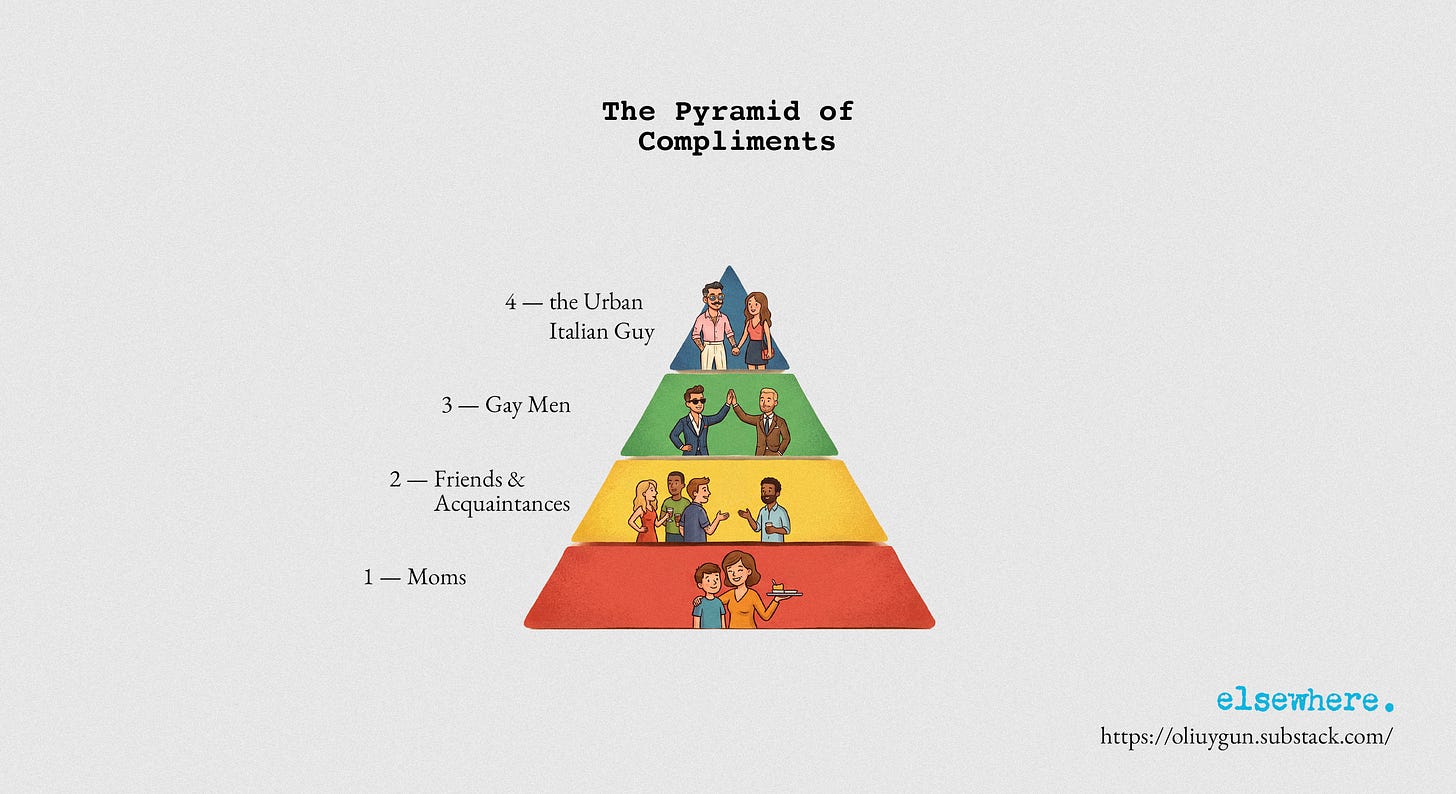
Compliments men receive ranked by how common they are
At the bottom of the pyramid sits a man’s ride or die. Your ardent cheerleader and the only die-hard fan of everything you do: your mom. Getting a compliment from your mom is like being handed a free snack on an economy flight. It’s not the most appetizing thing on the menu, but it’s always there and you’ll take it.
Then comes the friends & acquaintances tier. You know they only mean 30 % of what they said and they might just be buttering you up for a favor. But that’s OK. Their compliment still holds a kernel of truth and we know you’ll take that too.
The third tier is where it starts to get hot. Here sits the holy grail of any compliment, period: gay men. If you got a high five from a gay man, you know you followed the fashion gods flawlessly. They don’t just know what perfect is, they live with it. Because most grow up with internalized shame, their sense of perfection is simply impeccable (hey, I get to say that!)
But if you’re thinking gay men are sitting at the top of our pyramid, you’re wrong. There is an extremely specific group of people whose taste rules the pyramid and let me tell you they are a picky bunch:
I’m talking about the Urban Italian Guy.
In Italy, Taste Is Self-expression
Here’s how I received my first compliment from the Urban Italian Guy: We’re back in 2012, Bologna. As I’m rushing back to my apartment with groceries in my hands, I notice a guy walking towards me, holding hands with his girlfriend. As they draw nearer, I can see him looking me up and down until he finally goes:
“Ma che eleganza!” (wow what elegance!)
I stop to thank him as we do quattro chiacchiere (small talk). Our conversation ends with him inviting me to grab a drink with his friends (can you even imagine this happening in New York?)
Living in Italy and speaking the language gives you an insider’s perspective on how values and cultural tendencies shape taste here. Italian men love to express themselves. Everybody’s familiar with the gestures 🤌🏼 🤙🏼 👌🏼 but this goes well beyond that. I can easily spot an Italian uncle from a mile away anywhere in the world because the tell-tales are pretty obvious:
a pair of colorful tortoise shell glasses
fitted pleated pants but in a muted pastel color
a bold, playful beard, mustache or both.
naturally lean physique, with a little bit of a pancetta, no perfect shape
accessories, tattoos or both
Long story short, Italian taste derives from personal joy and self-expression. So look for anything expressive yet personal with a flair of sprezzatura (the art of looking stylish and put-together without any apparent effort). If that’s how you dress too, you don’t even have to look for a sign, they’ll instantly recognize it on you, letting you know and possibly inviting you for a drink (Thank you Luca!)
The research confirms this story too.
Italian luxury strength is mostly tied to hedonic craftsmanship and Made-in-Italy associations. Italian brands carry a durable country-of-origin advantage in fashion and footwear (Tafani et al., 2024 1 ; Godey et al., 2012 2 ). Hedonic serving as an academic way of saying for pleasure.
In France, Taste Is An Idea
Italy is not the only country where taste is strongly embedded in daily life. Yes! You guessed it right. I am going to talk about France now.
It’s the cursed year of 2020 and we’re somewhere outside Vannes in Bretagne (north-west corner of France). We’re sitting at an unassuming café, reading about a virus outbreak that we think we’ll never hear of again. My order is a simple, open bread dish. But there is something in it I can taste but cannot name. It sits at the back of my mouth and it has such a nostalgic familiarity.
When the waiter comes around, I ask her what it is. She lights up instantly (a rare sight in France) and informs us that she is also the owner. She then starts talking about how the recipe goes back to her grandmother but she tried something new with it, using the local grain in the bread instead of the one in the original recipe from Toulouse.
Now, isn’t that interesting? The stereotype is that the French are cold & distant. But as this instance goes to show, they’re not. You just have to drive out of Paris. Kidding. The truth is, they just have tiny obsessions (I use the word to actually mean it, not to be confused with the valley-girl-obsessions). Meaning they’re very, VERY particular about what they like and how they are open to innovate it. During my years in Europe, my superpower has always been finding the French person in a housewarming party and spending the rest of the night bonding with them over our shared hatred of a triviality.
That’s because in France, taste is an idea. An idea that is extremely detailed, comes from a traceable origin and has been finessed through various experiments over the years.
In fact, the academic research on taste and luxury in France revolves around 2 keywords: heritage and refinement. Therefore French consumers and brands put significant weight on provenance, aesthetics and refinement, treating luxury & taste as a form of creativity rather than as prestige (Bakir and colleagues, 2020 3 ; Tafani and colleagues, 2024 4 )
In New York, Taste Is a Name
If you read till here, thank you. Here’s your reward: now you get to hate me because I am going to talk about taste in my latest home, the United States.
The first time I thought about American taste was in the lobby of the Mark Hotel on 77th and Madison. My dog Mochi and I were waiting for our daily dose of sugar at the ice cream kiosk when a passerby went:
I love your hat, who made it?
To which I mumbled something like:
Um, I got it London.
The moment I said it, I realized even though I am pretty picky about what I wear, I don’t care that much about who I wear. I guess my personal taste is embedded in my worldview above anything else. As long as I connect with it on a personal level and it’s real fabric (I hate wearing synthetic), the label doesn’t matter to me. But it MUST have a specific story I can connect with. 90s Safari meets Tuxedo Mask meets Ottoman Empire? Sign me up! A mustache wax from a store that sells the same items in the same spot for 150 years? Take my money! Hoof shoes because a reclusive designer went to Japan and organized a runway around it. I’ll pass.
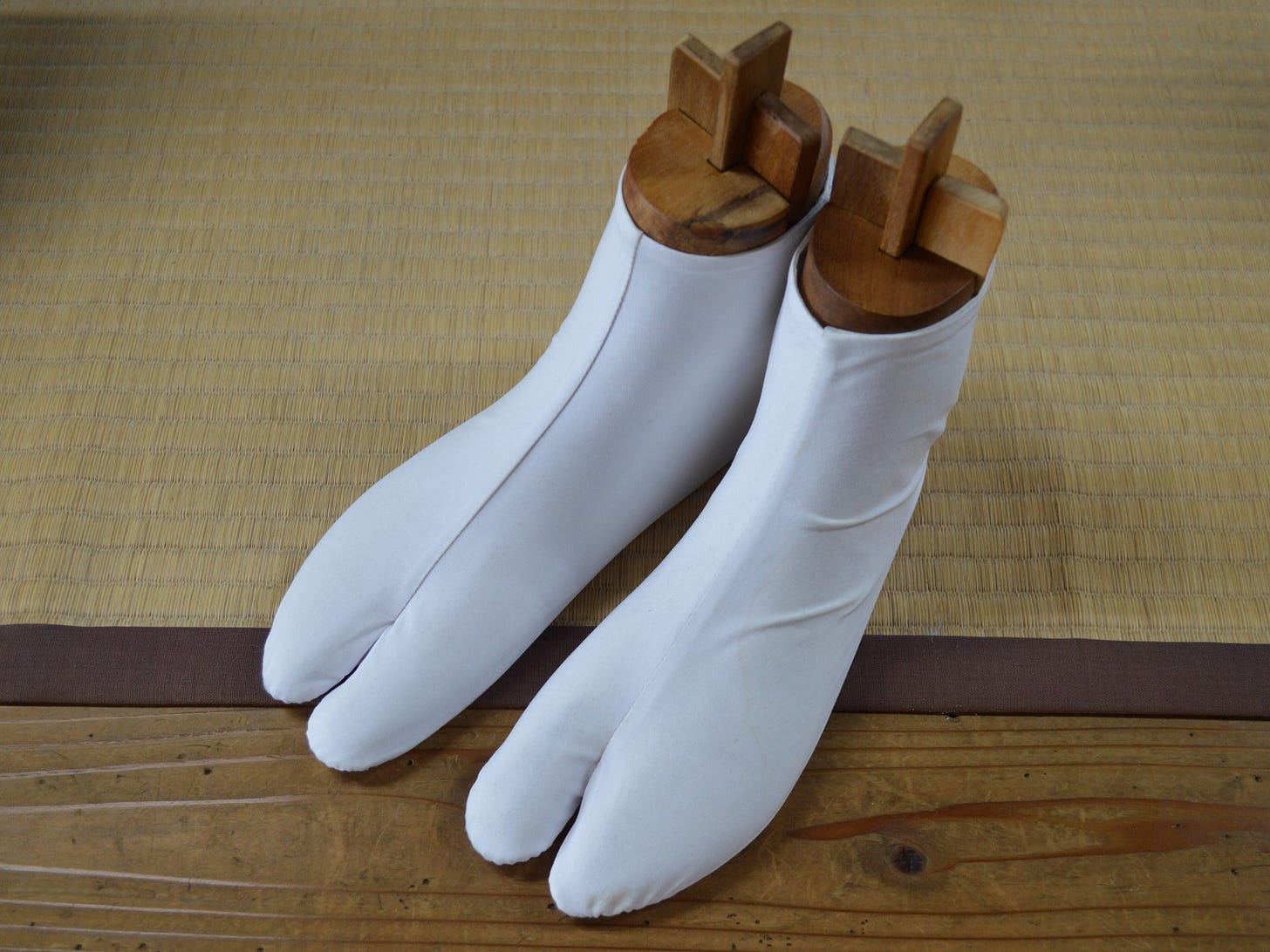
The original tabi socks popularized into Tabi Shoes by Maison Margiela
The woman in the lobby didn’t want to know why I picked that hat (hello Italy!), or its provenance (hello France!). She wanted to know its label. And that’s because in America, social clout by association is everything. Here, if you like to signal taste, you wear labels. That’s because the American economy monetized convenience from very early on. Why cook from scratch when you can pay more and order takeout? Why iron your shirt when you can send it out? Why learn how to form an opinion on art when you can buy a Chanel suit and pretend you have some? This is a results and convenience-oriented culture that appreciates pace and scale.
Social clout by association starts in your formative years out of a necessity here: Bullying. Surviving 6th grade entails hanging with the cool kids. If you can’t hang with them, you can at least signal your allegiance by wearing something they wear. Think about it: questioning the validity of the popular crowd’s taste, must be out of the question for a 6th grader. We’ve all seen Mean Girls. You know what? Those girls grow up to be adults. Adults who struggle to form an opinion on anything subjective because, well, it could have gotten them wedgied 10 years ago. Borrowing the opinion (and taste) of someone else who holds social clout, on the other hand?
That’s always the safest.
American luxury, an oxymoron?
Alright, now comes the time for the inevitable question. We know luxury is rooted in taste. If American culture prioritizes achievement and pace over heritage and joy, is American luxury devoid of taste? Or to put it more bluntly: Is American luxury an oxymoron?
Well, not quite. I think it exists but operates on a slightly different paradigm than its counterparts. Here is what the research says about the American luxury:
American luxury culture developed as competitive, achievement-oriented, pragmatic and visible, which supports status consumption and market expansion but not the slow heritage legitimacy that traditional luxury runs on (Naumova et al., 2019 5 ; Bakir et al., 2020 6 ; Zhou, 2024 7 ). What grew here instead is what Silverstein and Fiske called new luxury: middle-market consumers paying premiums of 20% to 200% for well-designed goods with artisanal touches. American houses are founder-led and entrepreneurial where European ones are generational (Doyle & Moore, 2017 8 ).
This explains the likes of Ralph Lauren, Cadillac, Harry Winston or the Tapestry, Inc brands. Brands that became the symbol of the American branch of luxury. But I still believe that American luxury is going through a transformation, slowly drawing closer to its European counterparts. That’s because the U.S. is going through its toughest identity crisis amid massive shifts in wealth generation, widening the income gap. How else can you explain culturally complex luxury examples that emerged recently such as Willy Chavarria or Veilance?
Truth be told, I’ve never tested this theory on the street. Meaning I haven’t received a single compliment on my outfit in New York yet. Who knows, perhaps the Urban American Guy is still struggling with complimenting fashion, but he is definitely thinking it. How do I know? From the compliments I get on my mustache! Assuming they’re not shit sandwiching me, we might be witnessing the birth of a new breed of taste (and luxury) soon.
And I can tell it’s going to be AWESOME

Waiting for Godot American Luxury
My Story
Want to get to know me more? Check out my posts on my personal story.
⟶ Cultural differences between New York & Amsterdam: The Sh*t Sandwich & the Art of Manhattan Etiquette
⟶ Why and how I moved to New York from Amsterdam: Tracing the Money Appetite from Amsterdam to New York
⟶ Why and how I quit my 9-5 to start a creative business: I lost my sight for 5 minutes and it landed me my dream job. Eventually.
Bibliography
Tafani, É., Vigneron, F., Azoulay, A., Crener, S., & Zahid, A. (2024). The influence of culture and gender in luxury brand consumption: A comparison across Western and Eastern culture consumers. Journal of International Marketing, 32, 58–80. https://doi.org/10.1177/1069031x241235629
Godey, B., Pederzoli, D., Aiello, G., Donvito, R., Chan, P., Oh, H., Singh, R., Skorobogatykh, I., Tsuchiya, J., & Weitz, B. A. (2012). Brand and country-of-origin effect on consumers’ decision to purchase luxury products. Journal of Business Research, 65, 1461–1470. https://doi.org/10.1016/j.jbusres.2011.10.012
Bakir, A., Gentina, E., & Gil, L. (2020). What shapes adolescents’ attitudes toward luxury brands? The role of self-worth, self-construal, gender and national culture. Journal of Retailing and Consumer Services, 57, 102208. https://doi.org/10.1016/j.jretconser.2020.102208
Naumova, O., Bilan, S., & Naumova, M. (2019). Luxury consumers’ behavior: A cross-cultural aspect. Innovative Marketing. https://doi.org/10.21511/im.15(4).2019.01
Zhou, C. (2024). Differential analysis of luxury brand extension strategies in different cultural contexts. Transactions on Economics, Business and Management Research. https://doi.org/10.62051/me7y6728
Silverstein, M., & Fiske, N. (2003). Luxury for the masses. Harvard Business Review, 81(4), 48–57.
Doyle, S., & Moore, C. (2017). Luxury brand outsiders: Understanding the success of British and American luxury brands (pp. 65–86). https://doi.org/10.1007/978-981-10-5236-1_4
Taste & The Pyramid of Compliments
The year is 2012. It’s a hot, humid August evening in Bologna, Italy. I am carrying groceries to my 17th century apartment (relax I am no heir, I was just an intern cosplaying as one). I’m wearing pleated pants in ivory and a fitted shirt in baby pink. I don’t know yet but this is a special day: in about 10 seconds, I am going to receive my first fashion compliment from another man.
Most men will not admit this, but getting a compliment on your taste from another man is a top-tier joy that doesn’t happen often. It certainly isn’t the same thing as getting a compliment from a woman. Let me share a chart I made out of my derrière so my point looks more credible. Ladies and whatever you identify as, I give you the pyramid of compliments.
Compliments men receive ranked by how common they are
At the bottom of the pyramid sits a man’s ride or die. Your ardent cheerleader and the only die-hard fan of everything you do: your mom. Getting a compliment from your mom is like being handed a free snack on an economy flight. It’s not the most appetizing thing on the menu, but it’s always there and you’ll take it.
Then comes the friends & acquaintances tier. You know they only mean 30 % of what they said and they might just be buttering you up for a favor. But that’s OK. Their compliment still holds a kernel of truth and we know you’ll take that too.
The third tier is where it starts to get hot. Here sits the holy grail of any compliment, period: gay men. If you got a high five from a gay man, you know you followed the fashion gods flawlessly. They don’t just know what perfect is, they live with it. Because most grow up with internalized shame, their sense of perfection is simply impeccable (hey, I get to say that!)
But if you’re thinking gay men are sitting at the top of our pyramid, you’re wrong. There is an extremely specific group of people whose taste rules the pyramid and let me tell you they are a picky bunch:
I’m talking about the Urban Italian Guy.
In Italy, Taste Is Self-expression
Here’s how I received my first compliment from the Urban Italian Guy: We’re back in 2012, Bologna. As I’m rushing back to my apartment with groceries in my hands, I notice a guy walking towards me, holding hands with his girlfriend. As they draw nearer, I can see him looking me up and down until he finally goes:
“Ma che eleganza!” (wow what elegance!)
I stop to thank him as we do quattro chiacchiere (small talk). Our conversation ends with him inviting me to grab a drink with his friends (can you even imagine this happening in New York?)
Living in Italy and speaking the language gives you an insider’s perspective on how values and cultural tendencies shape taste here. Italian men love to express themselves. Everybody’s familiar with the gestures 🤌🏼 🤙🏼 👌🏼 but this goes well beyond that. I can easily spot an Italian uncle from a mile away anywhere in the world because the tell-tales are pretty obvious:
a pair of colorful tortoise shell glasses
fitted pleated pants but in a muted pastel color
a bold, playful beard, mustache or both.
naturally lean physique, with a little bit of a pancetta, no perfect shape
accessories, tattoos or both
Long story short, Italian taste derives from personal joy and self-expression. So look for anything expressive yet personal with a flair of sprezzatura (the art of looking stylish and put-together without any apparent effort). If that’s how you dress too, you don’t even have to look for a sign, they’ll instantly recognize it on you, letting you know and possibly inviting you for a drink (Thank you Luca!)
The research confirms this story too.
Italian luxury strength is mostly tied to hedonic craftsmanship and Made-in-Italy associations. Italian brands carry a durable country-of-origin advantage in fashion and footwear (Tafani et al., 2024 1 ; Godey et al., 2012 2 ). Hedonic serving as an academic way of saying for pleasure.
In France, Taste Is An Idea
Italy is not the only country where taste is strongly embedded in daily life. Yes! You guessed it right. I am going to talk about France now.
It’s the cursed year of 2020 and we’re somewhere outside Vannes in Bretagne (north-west corner of France). We’re sitting at an unassuming café, reading about a virus outbreak that we think we’ll never hear of again. My order is a simple, open bread dish. But there is something in it I can taste but cannot name. It sits at the back of my mouth and it has such a nostalgic familiarity.
When the waiter comes around, I ask her what it is. She lights up instantly (a rare sight in France) and informs us that she is also the owner. She then starts talking about how the recipe goes back to her grandmother but she tried something new with it, using the local grain in the bread instead of the one in the original recipe from Toulouse.
Now, isn’t that interesting? The stereotype is that the French are cold & distant. But as this instance goes to show, they’re not. You just have to drive out of Paris. Kidding. The truth is, they just have tiny obsessions (I use the word to actually mean it, not to be confused with the valley-girl-obsessions). Meaning they’re very, VERY particular about what they like and how they are open to innovate it. During my years in Europe, my superpower has always been finding the French person in a housewarming party and spending the rest of the night bonding with them over our shared hatred of a triviality.
That’s because in France, taste is an idea. An idea that is extremely detailed, comes from a traceable origin and has been finessed through various experiments over the years.
In fact, the academic research on taste and luxury in France revolves around 2 keywords: heritage and refinement. Therefore French consumers and brands put significant weight on provenance, aesthetics and refinement, treating luxury & taste as a form of creativity rather than as prestige (Bakir and colleagues, 2020 3 ; Tafani and colleagues, 2024 4 )
In New York, Taste Is a Name
If you read till here, thank you. Here’s your reward: now you get to hate me because I am going to talk about taste in my latest home, the United States.
The first time I thought about American taste was in the lobby of the Mark Hotel on 77th and Madison. My dog Mochi and I were waiting for our daily dose of sugar at the ice cream kiosk when a passerby went:
I love your hat, who made it?
To which I mumbled something like:
Um, I got it London.
The moment I said it, I realized even though I am pretty picky about what I wear, I don’t care that much about who I wear. I guess my personal taste is embedded in my worldview above anything else. As long as I connect with it on a personal level and it’s real fabric (I hate wearing synthetic), the label doesn’t matter to me. But it MUST have a specific story I can connect with. 90s Safari meets Tuxedo Mask meets Ottoman Empire? Sign me up! A mustache wax from a store that sells the same items in the same spot for 150 years? Take my money! Hoof shoes because a reclusive designer went to Japan and organized a runway around it. I’ll pass.
The original tabi socks popularized into Tabi Shoes by Maison Margiela
The woman in the lobby didn’t want to know why I picked that hat (hello Italy!), or its provenance (hello France!). She wanted to know its label. And that’s because in America, social clout by association is everything. Here, if you like to signal taste, you wear labels. That’s because the American economy monetized convenience from very early on. Why cook from scratch when you can pay more and order takeout? Why iron your shirt when you can send it out? Why learn how to form an opinion on art when you can buy a Chanel suit and pretend you have some? This is a results and convenience-oriented culture that appreciates pace and scale.
Social clout by association starts in your formative years out of a necessity here: Bullying. Surviving 6th grade entails hanging with the cool kids. If you can’t hang with them, you can at least signal your allegiance by wearing something they wear. Think about it: questioning the validity of the popular crowd’s taste, must be out of the question for a 6th grader. We’ve all seen Mean Girls. You know what? Those girls grow up to be adults. Adults who struggle to form an opinion on anything subjective because, well, it could have gotten them wedgied 10 years ago. Borrowing the opinion (and taste) of someone else who holds social clout, on the other hand?
That’s always the safest.
American luxury, an oxymoron?
Alright, now comes the time for the inevitable question. We know luxury is rooted in taste. If American culture prioritizes achievement and pace over heritage and joy, is American luxury devoid of taste? Or to put it more bluntly: Is American luxury an oxymoron?
Well, not quite. I think it exists but operates on a slightly different paradigm than its counterparts. Here is what the research says about the American luxury:
American luxury culture developed as competitive, achievement-oriented, pragmatic and visible, which supports status consumption and market expansion but not the slow heritage legitimacy that traditional luxury runs on (Naumova et al., 2019 5 ; Bakir et al., 2020 6 ; Zhou, 2024 7 ). What grew here instead is what Silverstein and Fiske called new luxury: middle-market consumers paying premiums of 20% to 200% for well-designed goods with artisanal touches. American houses are founder-led and entrepreneurial where European ones are generational (Doyle & Moore, 2017 8 ).
This explains the likes of Ralph Lauren, Cadillac, Harry Winston or the Tapestry, Inc brands. Brands that became the symbol of the American branch of luxury. But I still believe that American luxury is going through a transformation, slowly drawing closer to its European counterparts. That’s because the U.S. is going through its toughest identity crisis amid massive shifts in wealth generation, widening the income gap. How else can you explain culturally complex luxury examples that emerged recently such as Willy Chavarria or Veilance?
Truth be told, I’ve never tested this theory on the street. Meaning I haven’t received a single compliment on my outfit in New York yet. Who knows, perhaps the Urban American Guy is still struggling with complimenting fashion, but he is definitely thinking it. How do I know? From the compliments I get on my mustache! Assuming they’re not shit sandwiching me, we might be witnessing the birth of a new breed of taste (and luxury) soon.
And I can tell it’s going to be AWESOME
Waiting for Godot American Luxury
My Story
Want to get to know me more? Check out my posts on my personal story.
⟶ Cultural differences between New York & Amsterdam: The Sh*t Sandwich & the Art of Manhattan Etiquette
⟶ Why and how I moved to New York from Amsterdam: Tracing the Money Appetite from Amsterdam to New York
⟶ Why and how I quit my 9-5 to start a creative business: I lost my sight for 5 minutes and it landed me my dream job. Eventually.
Bibliography
Tafani, É., Vigneron, F., Azoulay, A., Crener, S., & Zahid, A. (2024). The influence of culture and gender in luxury brand consumption: A comparison across Western and Eastern culture consumers. Journal of International Marketing, 32, 58–80. https://doi.org/10.1177/1069031x241235629
Godey, B., Pederzoli, D., Aiello, G., Donvito, R., Chan, P., Oh, H., Singh, R., Skorobogatykh, I., Tsuchiya, J., & Weitz, B. A. (2012). Brand and country-of-origin effect on consumers’ decision to purchase luxury products. Journal of Business Research, 65, 1461–1470. https://doi.org/10.1016/j.jbusres.2011.10.012
Bakir, A., Gentina, E., & Gil, L. (2020). What shapes adolescents’ attitudes toward luxury brands? The role of self-worth, self-construal, gender and national culture. Journal of Retailing and Consumer Services, 57, 102208. https://doi.org/10.1016/j.jretconser.2020.102208
Naumova, O., Bilan, S., & Naumova, M. (2019). Luxury consumers’ behavior: A cross-cultural aspect. Innovative Marketing. https://doi.org/10.21511/im.15(4).2019.01
Zhou, C. (2024). Differential analysis of luxury brand extension strategies in different cultural contexts. Transactions on Economics, Business and Management Research. https://doi.org/10.62051/me7y6728
Silverstein, M., & Fiske, N. (2003). Luxury for the masses. Harvard Business Review, 81(4), 48–57.
Doyle, S., & Moore, C. (2017). Luxury brand outsiders: Understanding the success of British and American luxury brands (pp. 65–86). https://doi.org/10.1007/978-981-10-5236-1_4

Oli Uygun