
Build a silly brand, silly!
Build a silly brand, silly!
Build a silly brand, silly!
1. WHERE DID YOUR SILLY GO?
In college, I had a friend who once made a corsage out of a mesh bottle sleeve. Not just for fun, she actually wore it to a concert. And my god did I trust her fashion sense! I remember letting her paint a heart on my cheek one time. With red nail polish, mind you. Just to sing some Jason Mraz songs into a lens.
We were NOT cool.
Another friend of mine played in a trash band wearing a I’m with stupid shirt and a man bun. They knew they sucked but they played in public anyway.
Sadly, I don’t see any of those people being silly in that capacity anymore. If I ever see them IRL, that is.
We all maintain a rather serious existence these days, don’t we? You might be thinking serious comes with age, but I refuse to believe that. When I spend time with these people in private, I still catch that glimpse of silly at times. The spark is there. I know they’re still full of outlandish ideas (the occasional dad jokes give them away). Or that they still want to start silly ventures and make better mistakes. But I get the impression that they can only embrace that side with the very few they trust. When they’re speaking with the rest of the world, they’re wearing a mask.
I mean can you blame them? Every other human being around us is carrying a recording device. In the face of the flashing light, our silly self has learned to hide.
Hey, that rhymed!
I told you we were NOT cool.
2. THE SILLY BUSINESS
Let’s not fool each other. I know you have a mask too. I see you wear it when you say “I appreciate you” to the woman at the counter. I also know what you’re thinking: Why do we suddenly have to start telling servers we appreciate them. Isn’t that what thank you was for?
I know that you think it too because I’m standing right behind you in the line waiting for my turn to perform it. Also because I used to be the guy from marketing you said your fake hello hellos to by the watercooler. Which is why I’m taking the matter in my own hands.
Silly used to be fun and it has now become a fear. I think we need to reclaim it and make it a part of our lives again. And not just for funsies. But to find out the kinds of things we ourselves can build. Things that bring us joy again. Brands run by real people that we can trust and support.
And I have a feeling a lot of people are already trying.
Americans filed 5.5 million business applications in 2023. A record year, and applications from the kind of business likely to hire someone ran 37 % above 2019. It wasn’t a pandemic blip either. So far in 2026, the monthly rate is still around 45 % above where it was before 2020.1
I think these people are in luck because this might be a great time for many people to build something fresh. Science says our appetite for direct, human-first communication is off the charts. In a study conducted across the US and the UK, researchers ran headlines past about five thousand people. Anything labelled AI-generated got rated as less accurate and less worth sharing. Even those that were actually true and were written by a human being. The AI label by itself was enough to do the damage.2
So data looks favorable: Silly might just be open for business.
But you see, this is also where it gets uncomfortable. Because if silly is now a market opportunity, and you go pursue it on purpose, haven’t you already killed it? If silly thrives on your genuine self, is it even realistically possible to incorporate it into a business?
In other words: is silly in business, a silly business?
The research points the same way on the payoff. Across studies of influencers and the brands that hire them, the thing that earns trust is whether people believe you mean it. Perceived authenticity moves trust, brand attitude, purchase intention and loyalty. And it appears to do it through emotional attachment.
Audiences bond with whoever they read as real, and once they’ve bonded, they mostly stop questioning them.3
Though notice who that research is studying: Influencers. The most rehearsed, most focus-grouped authenticity on earth. So the finding cuts both ways. People reward what feels real, and that is exactly why so much of what we see today is being engineered to feel that way.
3. LOSING YOUR FILTER
Let’s say you harnessed the power of your silly and managed to build a business around it. And you’re making the rounds aboard the mothership of all dreads. The dread we’re all dreading:
Networking.
There are two ways you can be silly while out and about in a professional capacity. You can either A) compartmentalize, keeping your business and personal self apart and have a few silly jokes up your sleeve ready to fire or B) walk in as yourself and say what you’re actually thinking in that exact moment (otherwise known as conversation) and find out what that can cost you and your business.
Option A will always be the safest, albeit a dull and transactional one. Think Chandler Bing’s work laugh.
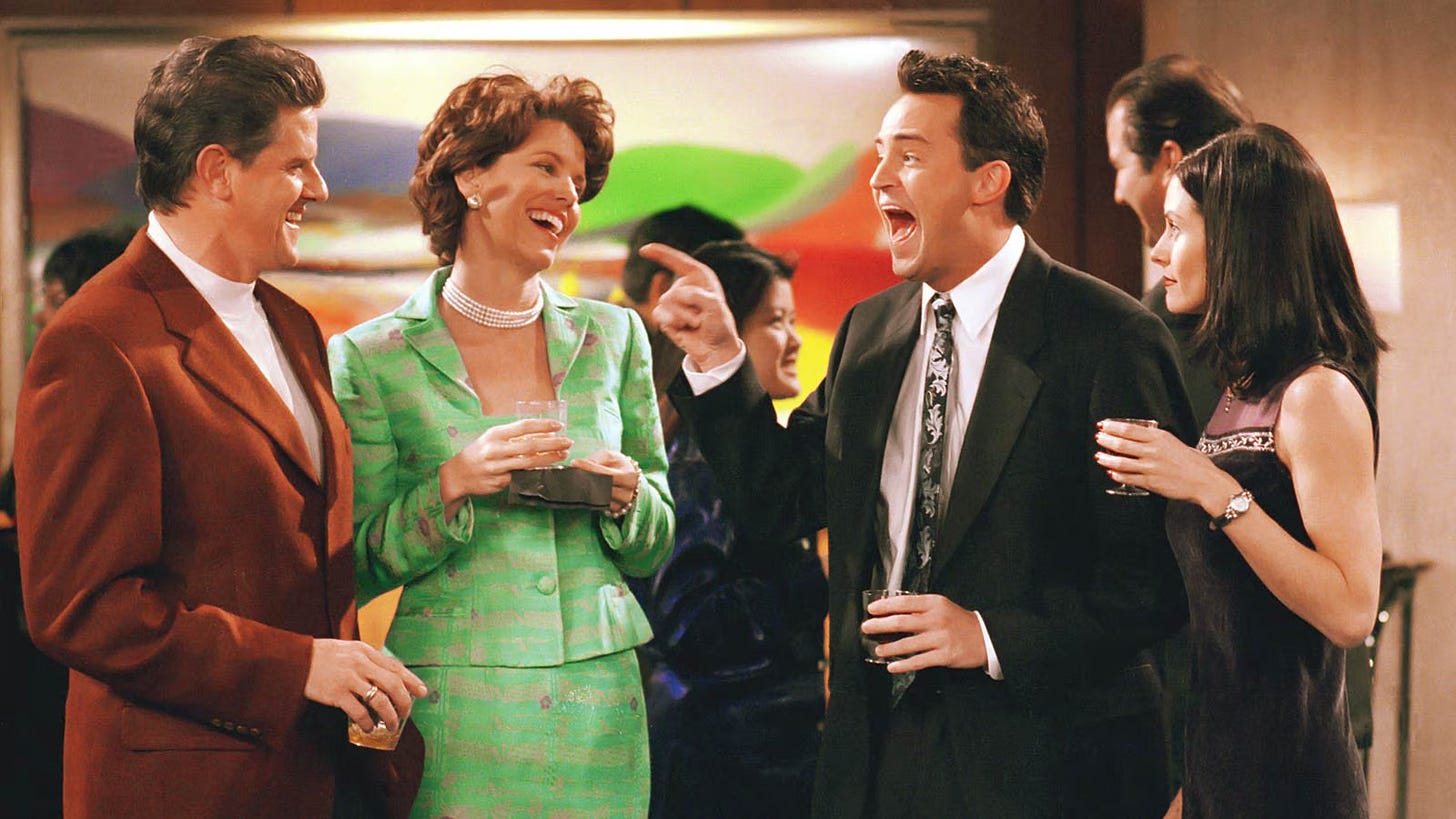
Chandler Bing’s work laugh
Option B, on the other hand, sounds super cool but it can also leave you in a very difficult social situation. I don’t have to go far for this one, it happened to me quite recently:
I was at this mixer thing a few months back, somewhere in Brooklyn, let’s leave it at that.
It was supposed to be an evening bringing together emerging pioneers of the creative industries, whatever that means. Actually, looking back, the word pioneer should’ve been a red flag, but I guess I was just too eager to meet some new people.
So I’m there, arrived fashionably late, as you do in New York. And there’s an open bar. So I just grabbed a drink and approached a circle of “young pioneers”. It’s all US open this, fashion week that till someone goes: I can’t really place your accent, which I get quite often here as a non-native speaker.
And I tell them that I recently moved from Amsterdam.
One of the ladies asked if I missed anything in particular about Amsterdam. I believe her exact words were, something that can only happen in Amsterdam, or something along those lines.
But my silly international brain registered this as genuine interest, so I told them about my dog’s groomer: You see in my 8 years in Amsterdam, my dog Mochi got groomed right in the middle of De Wallen, aka the red light district. And every month I took him there, we’d be photographed by hundreds of people because I’d carry him in a basket attached to my bike, which I’d park nearby (no aesthetic, that’s just what you do in Amsterdam). So I’d often walk the bike with Mochi inside the basket, across the glass sex workers waited behind. And tourists would snap photos of us, even though it’s illegal to photograph the workers there. I was so desensitized to the whole thing, of course, that I was not even fazed by the tourist gaze. Mochi and I actually made friends with a few of the workers there too, so they’d greet him, and wave at him.
See? I’m doing it again, I’m losing my filter.
It’s a sickness.
Anyway, back to the ladies. So these people hadn’t been to Amsterdam at all, so my very Amsterdam story went right above heads, and I ended up being the guy who brought up hookers in a fancy members-only social club. To save face, I said a few remotely relevant things revealing I was gay, but that went out the window too. Because guess what, I’m not great at that lingo either.
And just like that, I was cast away as a weirdo who brought up hookers for no reason and that was that.
4. THE ART OF BENIGN VIOLATION
Experiments succeed and fail. Mine might have crossed the boundaries of social etiquette that day, but that doesn’t mean there aren’t safer methods.
A 2025 study across multiple countries found that the tighter a culture’s norms are, the less humor its people actually produce. Not less humor consumed. Less humor made. Which is a polite way of saying that when the rules get heavy, people stop trying.4
But do they really? If you look closely, you’ll see people are still on the lookout for their silly.
I keep seeing big, buff guys social-knitting on the L train. Or grownups with nose rings and podcasts playing backgammon at the Soho House. Some of my friends pay good money just to tuft, embroider or learn about astrology on the weekends. My theory is that it’s partly because they want to do something without having to think about what others would think, or how good they can be at it, or at the very least what it can lead to.
They haven’t given up on us. Quite the contrary, they’re experimenting. Perhaps they just want to break a rule. But without hurting anyone. It’s actually a thing people do to break the fourth wall, and have fun (or be silly, I guess). It’s called benign violation.
Back in 2010, McGraw and Warren used the term benign violation for the first time. It is a psychological concept proposing that humor occurs when a situation is simultaneously perceived as a violation and as benign.5
So people think something is funny when it breaks a rule but still feels safe. A very fine line, if you ask me. Break a tiny rule, and your story is silly so you don’t have to be. And people possibly remember what you do for a living.
But break a slightly big one, you’re in court.
Who draws the fine line? What constitutes tiny and what constitutes big? I don’t think there’s a clean answer. But there are people who have worked it out for themselves, so let’s go look at them.
5. THREE SILLY BUSINESSES
There are businesses that are already implementing the benign violation, on various scales.
5.1 Level One: Liquid Death
Murder your thirst!
There is no other recent brand that does it better than Liquid Death. This canned water brand is the definition of benign violation. Liquid Death doesn’t kill you (surprise surprise). It just kindly kills your thirst. It has a loud, illustrative joyful personality. My millennial brain registers it as Avril Lavigne for sober men, but I have a feeling its audience perceives much differently. As in glam rock meets 90s Japanese commercial.
Though let’s be honest about what this is. Liquid Death was built by an ad man. Mike Cessario spent years in agencies watching clients pick the safe idea over the good one, so he went and built the unsafe one himself. The punk persona was engineered. On purpose. By a professional.
Which is worth saying out loud: performed silly can work, and it can work at scale. It works here because they never wink at the camera. Not once. Level one is a costume, and a very good one. But it is still a costume, and somebody has to keep wearing it.
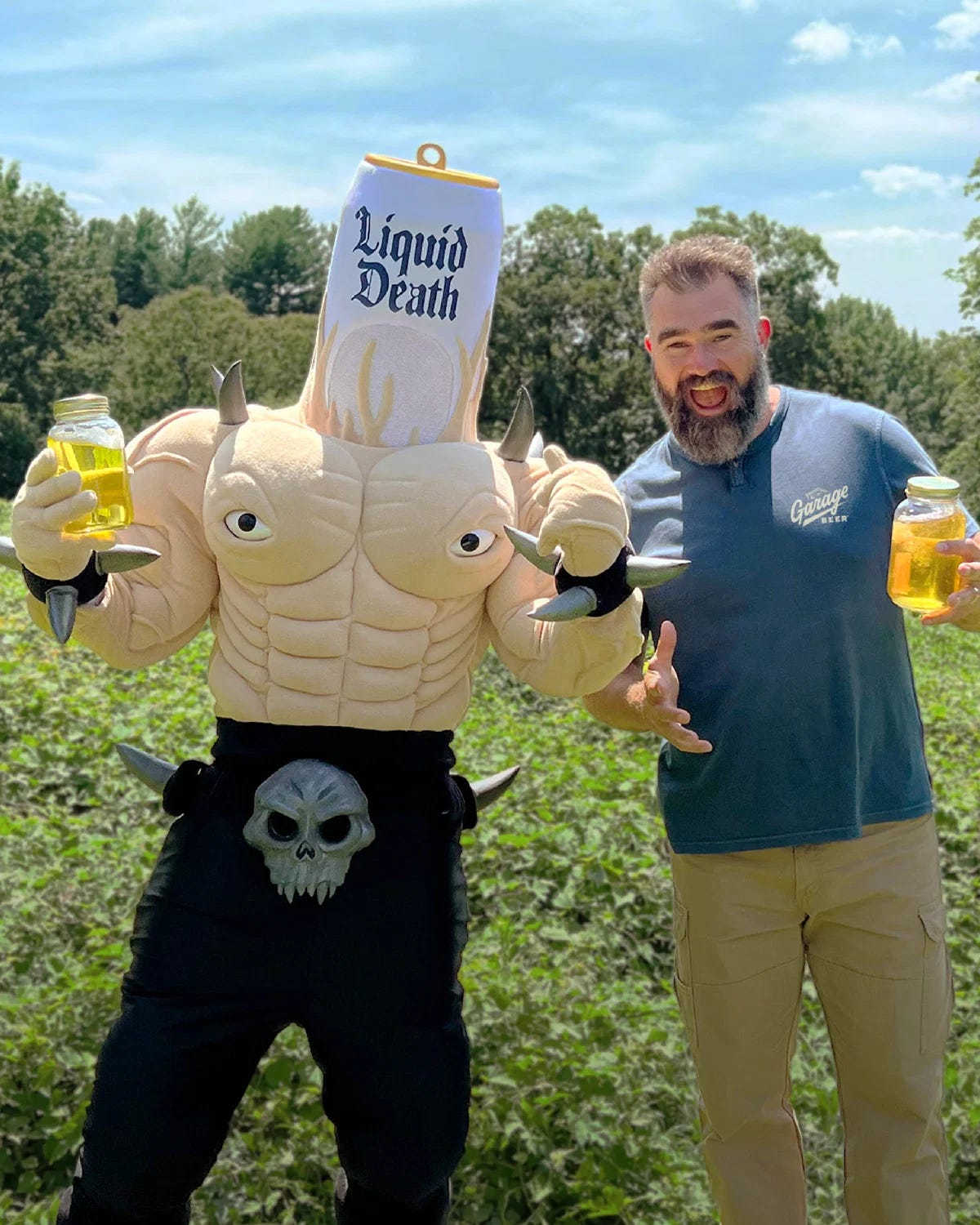
From Liquid Death + Garage Beer, We Want Your Pee, 2026
What is furniture?
Torino based furniture brand Gufram has been asking that since 1966.
Gufram’s Bocca sofa is a giant pair of red lips, designed by Studio 65 in 1970, lifted from Dalí’s Mae West portrait. Their Cactus is another breed of beautiful silly. A green foam cactus you hang your coat on. Both of these items are still in production. And both are sold as numbered limited editions, with some originals sitting in the Pompidou and the Design Museum in London.6
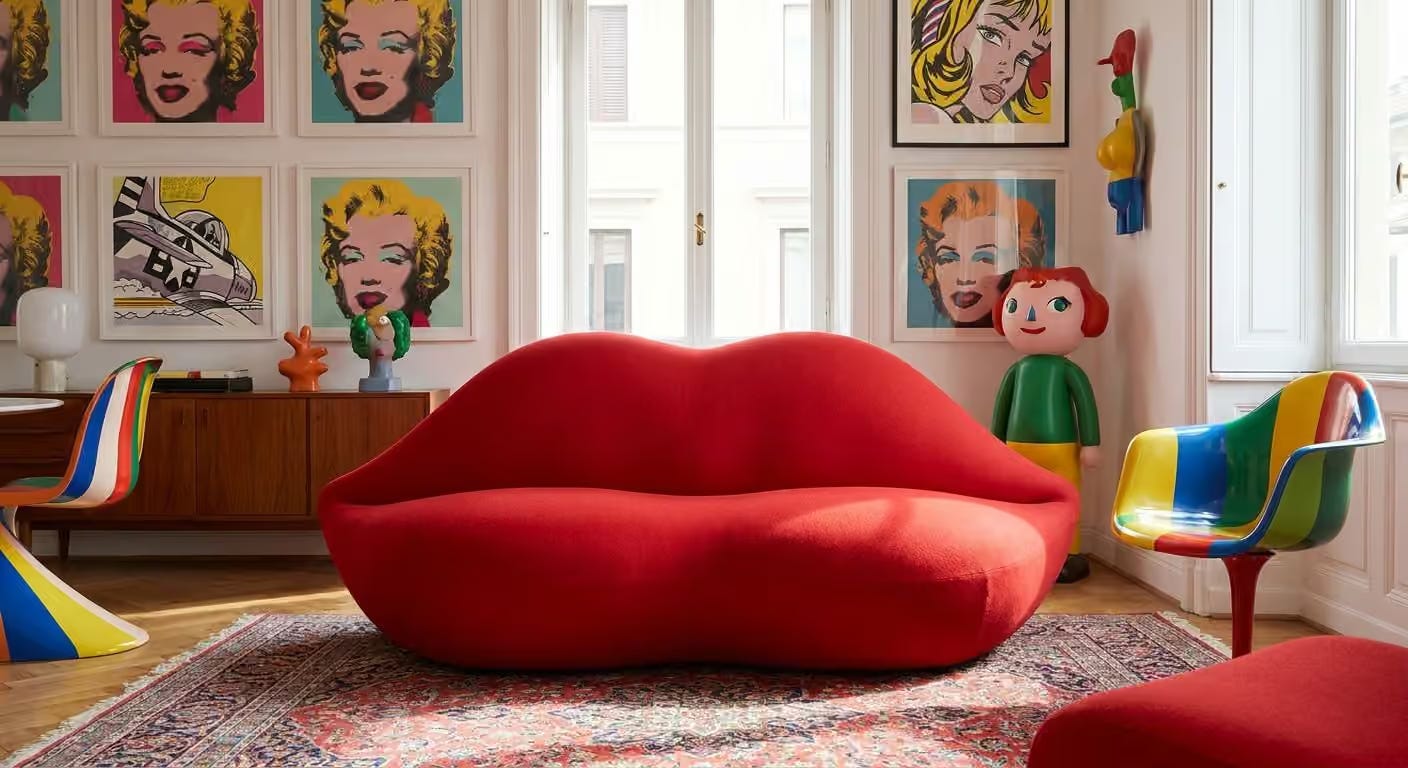
Bocca Sofa designed by Studio 65, 1970
Think about what that takes. You are asking someone to pay collectible-design money for a couch shaped like lips (Pouty ones, at that!). Gufram possibly priced it as it is because they knew they would find the audience who would get their silly. And they held that position for over fifty years. Level two silly is sharing your silly with the rest of the world with no filter on, and slowly connecting with those who match your silly and raise it.
Before we move on, please consider visiting Gufram’s website, you’ll see the silly right there!
5.3 Level Three: Duran Lantink
Vulva pants, anyone?
To me Duran Lantink is very Amsterdam, which is probably why his stuff resonates with me. Duran is a designer celebrated for his innovative, upcycled pieces that challenge consumerism. He is a beast in the atelier. He slices and reconstructs deadstock luxury garments. And then he turns them boundary-pushing, collage-like silhouettes.
For autumn/winter 2025 he sent a male model out in silicone breasts and a female model in a sculpted male torso. In April 2025, Jean Paul Gaultier named him creative director, the first permanent one since Gaultier himself stopped showing in 2020. His debut landed in Paris that October and split the room down the middle.7
But before any of that, in 2018, he made these beautiful trousers that made waves on the internet. If you’ve seen Janelle Monáe’s Pynk video, you’ve seen these ruffled pink pants shaped like a vulva.

from Janelle Monáe’s video clip Pynk
As you can see, level three is personal. If it weren’t for my 8 years in Amsterdam, I wouldn’t have put Lantink on this list. The reason I did is because I can feel the dry, Dutch humor in his work. That egalitarian, no-nonsense social commentary has a little bit silly in it. It’s like talking to my neighbors again. A very familiar, unfiltered silly which I cherish and sorely miss at times.
Of course, as with anything personal, this breed of silly can get political too. At the end of the day, it is a person making a thing with bare hands and pouring their worldview into it, without worrying about what others might think. It will get some heat but it will also encourage many to debate, question and participate. Which is likely why it became so successful.
6. BUILD A SILLY BRAND, SILLY!
Notice the pattern?
Liquid Death gives you a safe yet loud enough personality.
Gufram equips you with edge & whimsy. Makes you an acquired taste, if you will.
Lantink shares a rather bold worldview that isn’t afraid to be disliked at all. You either endorse it, or not.
All three are proof that there is a difference between performing silly and being silly. Finding your silly and pouring it into whatever you’re building can be a liability waiting to happen, but it is precisely why it works.
And that’s your answer to that question. Silly doesn’t die when we do it on purpose. But it might die if we resort to testing it first.
How do I know, right? Well, I’ve been an outsider in five countries (hence, the name ELSEWHERE for this publication). The one thing that’s worked everywhere has been saying what you actually think. Trust me. People sense these things. If your ignorance comes from a place of genuine curiosity, they won’t care about the etiquette. Most will welcome your take.
Yes, some might write you off as a weirdo. But they’ll be a minority.
And that’s just life.
7. FINDING YOUR SILLY
So, what do we do with all this talk about the silly business? Put it to good use, of course!
If you’d like to reclaim your silly, I would advise to start with one question, and answer it honestly before reading the next paragraph.
What is one thing you already say about your practice in private, to your friends and family, perhaps after two drinks? Something you’d never put on the website. Write down the first thing that comes up, exactly as you think it.
Now go pull up your brand’s homepage. If there is a gap between those two pictures, you’ve found your way back to your silly.
There is a comprehensive method we’ve been utilizing at Atelier WOO for years, but that one is for the next essay.
So I’ll have to say goodbye for now.
But I’ll see ya later,
GATOR 🐊
8. FURTHER READING
If any of this got its hooks in you, here’s some more reading you might find helpful. Most of these papers are behind journal paywalls, so I suggest a library login. Emailing the authors also works since academics are usually thrilled anyone asked (can you blame them?)
Warren, C., Barsky, A., & McGraw, A. P. (2018). Humor, Comedy, and Consumer Behavior. Journal of Consumer Research, 45.
Howe, H. S., Zhou, L., Dias, R. S., & Fitzsimons, G. (2022). Aha over Haha: Brands Benefit More From Being Clever Than From Being Funny. Journal of Consumer Psychology.
Warren, C., Carter, E., & McGraw, A. P. (2019). Being funny is not enough: the influence of perceived humor and negative emotional reactions on brand attitudes. International Journal of Advertising, 38.
Oba, D., Howe, H. S., & Fitzsimons, G. (2024). Brand Teasing: How Brands Build Strong Relationships by Making Fun of Their Consumers. Journal of Consumer Research.
Baek, T. H., Park, J., & Kim, J. S. (2025). Meme advertising for luxury brands: effects on perceived funniness and sharing intention. International Journal of Advertising, 45.
Kim, D. Y., & Kim, H.-Y. (2021). Trust me, trust me not: A nuanced view of influencer marketing on social media. Journal of Business Research, 134, 223-232.
Schlaegel, C., & Koenig, M. (2014). Determinants of Entrepreneurial Intent: A Meta-Analytic Test and Integration of Competing Models. Entrepreneurship Theory and Practice, 38(2), 291-332.
Proyer, R., & Sendatzki, R. (2025). Examining Play and Playfulness at Work. Annual Review of Organizational Psychology and Organizational Behavior.
Huizinga, J. (1938). Homo Ludens: A Study of the Play-Element in Culture.
1 Fikri, K., & Newman, D. (2024, January 12). Business Applications Eked Out a New Record in 2023. Economic Innovation Group. Current monthly levels from the US Census Bureau, Business Formation Statistics, August 2026 release. Pre-pandemic monthly baseline from Eckhardt, S. (2024, December 20). The Year in Business Dynamism. Economic Innovation Group.
2 Altay, S., & Gilardi, F. (2024). People are skeptical of headlines labeled as AI-generated, even if true or human-made, because they assume full AI automation. PNAS Nexus, 3(10).
3 Lou, C., & Yuan, S. (2019). Influencer Marketing: How Message Value and Credibility Affect Consumer Trust of Branded Content on Social Media. Journal of Interactive Advertising, 19, 58-73. Roth-Cohen, O., Segev, S., & Liu, Y. (2024). The effect of non-celebrity influencers’ perceived authenticity on social media advertising outcomes. International Journal of Advertising, 44, 1017-1039.
4 Cao, Y., Hou, Y., Wang, Y., & Ji, L.-J. (2025). Cultural Tightness Reduces Humor Production: Evidence from Multiple Countries. American Psychologist.
5 McGraw, A. P., & Warren, C. (2010). Benign Violations: Making Immoral Behavior Funny. Psychological Science, 21(8), 1141-1149.
6 Gufram, Bocca sofa product page and company overview. Background on the house: The Guide Magazine, “Gufram Furniture: Radical Italian Design Since 1966”.
7 Business of Fashion, “Jean Paul Gaultier Names Duran Lantink Creative Director”. On the debut: Dazed, “Jean Paul Gaultier SS26: Inside Duran Lantink’s disruptive debut”.
1. WHERE DID YOUR SILLY GO?
In college, I had a friend who once made a corsage out of a mesh bottle sleeve. Not just for fun, she actually wore it to a concert. And my god did I trust her fashion sense! I remember letting her paint a heart on my cheek one time. With red nail polish, mind you. Just to sing some Jason Mraz songs into a lens.
We were NOT cool.
Another friend of mine played in a trash band wearing a I’m with stupid shirt and a man bun. They knew they sucked but they played in public anyway.
Sadly, I don’t see any of those people being silly in that capacity anymore. If I ever see them IRL, that is.
We all maintain a rather serious existence these days, don’t we? You might be thinking serious comes with age, but I refuse to believe that. When I spend time with these people in private, I still catch that glimpse of silly at times. The spark is there. I know they’re still full of outlandish ideas (the occasional dad jokes give them away). Or that they still want to start silly ventures and make better mistakes. But I get the impression that they can only embrace that side with the very few they trust. When they’re speaking with the rest of the world, they’re wearing a mask.
I mean can you blame them? Every other human being around us is carrying a recording device. In the face of the flashing light, our silly self has learned to hide.
Hey, that rhymed!
I told you we were NOT cool.
2. THE SILLY BUSINESS
Let’s not fool each other. I know you have a mask too. I see you wear it when you say “I appreciate you” to the woman at the counter. I also know what you’re thinking: Why do we suddenly have to start telling servers we appreciate them. Isn’t that what thank you was for?
I know that you think it too because I’m standing right behind you in the line waiting for my turn to perform it. Also because I used to be the guy from marketing you said your fake hello hellos to by the watercooler. Which is why I’m taking the matter in my own hands.
Silly used to be fun and it has now become a fear. I think we need to reclaim it and make it a part of our lives again. And not just for funsies. But to find out the kinds of things we ourselves can build. Things that bring us joy again. Brands run by real people that we can trust and support.
And I have a feeling a lot of people are already trying.
Americans filed 5.5 million business applications in 2023. A record year, and applications from the kind of business likely to hire someone ran 37 % above 2019. It wasn’t a pandemic blip either. So far in 2026, the monthly rate is still around 45 % above where it was before 2020.1
I think these people are in luck because this might be a great time for many people to build something fresh. Science says our appetite for direct, human-first communication is off the charts. In a study conducted across the US and the UK, researchers ran headlines past about five thousand people. Anything labelled AI-generated got rated as less accurate and less worth sharing. Even those that were actually true and were written by a human being. The AI label by itself was enough to do the damage.2
So data looks favorable: Silly might just be open for business.
But you see, this is also where it gets uncomfortable. Because if silly is now a market opportunity, and you go pursue it on purpose, haven’t you already killed it? If silly thrives on your genuine self, is it even realistically possible to incorporate it into a business?
In other words: is silly in business, a silly business?
The research points the same way on the payoff. Across studies of influencers and the brands that hire them, the thing that earns trust is whether people believe you mean it. Perceived authenticity moves trust, brand attitude, purchase intention and loyalty. And it appears to do it through emotional attachment.
Audiences bond with whoever they read as real, and once they’ve bonded, they mostly stop questioning them.3
Though notice who that research is studying: Influencers. The most rehearsed, most focus-grouped authenticity on earth. So the finding cuts both ways. People reward what feels real, and that is exactly why so much of what we see today is being engineered to feel that way.
3. LOSING YOUR FILTER
Let’s say you harnessed the power of your silly and managed to build a business around it. And you’re making the rounds aboard the mothership of all dreads. The dread we’re all dreading:
Networking.
There are two ways you can be silly while out and about in a professional capacity. You can either A) compartmentalize, keeping your business and personal self apart and have a few silly jokes up your sleeve ready to fire or B) walk in as yourself and say what you’re actually thinking in that exact moment (otherwise known as conversation) and find out what that can cost you and your business.
Option A will always be the safest, albeit a dull and transactional one. Think Chandler Bing’s work laugh.
Chandler Bing’s work laugh
Option B, on the other hand, sounds super cool but it can also leave you in a very difficult social situation. I don’t have to go far for this one, it happened to me quite recently:
I was at this mixer thing a few months back, somewhere in Brooklyn, let’s leave it at that.
It was supposed to be an evening bringing together emerging pioneers of the creative industries, whatever that means. Actually, looking back, the word pioneer should’ve been a red flag, but I guess I was just too eager to meet some new people.
So I’m there, arrived fashionably late, as you do in New York. And there’s an open bar. So I just grabbed a drink and approached a circle of “young pioneers”. It’s all US open this, fashion week that till someone goes: I can’t really place your accent, which I get quite often here as a non-native speaker.
And I tell them that I recently moved from Amsterdam.
One of the ladies asked if I missed anything in particular about Amsterdam. I believe her exact words were, something that can only happen in Amsterdam, or something along those lines.
But my silly international brain registered this as genuine interest, so I told them about my dog’s groomer: You see in my 8 years in Amsterdam, my dog Mochi got groomed right in the middle of De Wallen, aka the red light district. And every month I took him there, we’d be photographed by hundreds of people because I’d carry him in a basket attached to my bike, which I’d park nearby (no aesthetic, that’s just what you do in Amsterdam). So I’d often walk the bike with Mochi inside the basket, across the glass sex workers waited behind. And tourists would snap photos of us, even though it’s illegal to photograph the workers there. I was so desensitized to the whole thing, of course, that I was not even fazed by the tourist gaze. Mochi and I actually made friends with a few of the workers there too, so they’d greet him, and wave at him.
See? I’m doing it again, I’m losing my filter.
It’s a sickness.
Anyway, back to the ladies. So these people hadn’t been to Amsterdam at all, so my very Amsterdam story went right above heads, and I ended up being the guy who brought up hookers in a fancy members-only social club. To save face, I said a few remotely relevant things revealing I was gay, but that went out the window too. Because guess what, I’m not great at that lingo either.
And just like that, I was cast away as a weirdo who brought up hookers for no reason and that was that.
4. THE ART OF BENIGN VIOLATION
Experiments succeed and fail. Mine might have crossed the boundaries of social etiquette that day, but that doesn’t mean there aren’t safer methods.
A 2025 study across multiple countries found that the tighter a culture’s norms are, the less humor its people actually produce. Not less humor consumed. Less humor made. Which is a polite way of saying that when the rules get heavy, people stop trying.4
But do they really? If you look closely, you’ll see people are still on the lookout for their silly.
I keep seeing big, buff guys social-knitting on the L train. Or grownups with nose rings and podcasts playing backgammon at the Soho House. Some of my friends pay good money just to tuft, embroider or learn about astrology on the weekends. My theory is that it’s partly because they want to do something without having to think about what others would think, or how good they can be at it, or at the very least what it can lead to.
They haven’t given up on us. Quite the contrary, they’re experimenting. Perhaps they just want to break a rule. But without hurting anyone. It’s actually a thing people do to break the fourth wall, and have fun (or be silly, I guess). It’s called benign violation.
Back in 2010, McGraw and Warren used the term benign violation for the first time. It is a psychological concept proposing that humor occurs when a situation is simultaneously perceived as a violation and as benign.5
So people think something is funny when it breaks a rule but still feels safe. A very fine line, if you ask me. Break a tiny rule, and your story is silly so you don’t have to be. And people possibly remember what you do for a living.
But break a slightly big one, you’re in court.
Who draws the fine line? What constitutes tiny and what constitutes big? I don’t think there’s a clean answer. But there are people who have worked it out for themselves, so let’s go look at them.
5. THREE SILLY BUSINESSES
There are businesses that are already implementing the benign violation, on various scales.
5.1 Level One: Liquid Death
Murder your thirst!
There is no other recent brand that does it better than Liquid Death. This canned water brand is the definition of benign violation. Liquid Death doesn’t kill you (surprise surprise). It just kindly kills your thirst. It has a loud, illustrative joyful personality. My millennial brain registers it as Avril Lavigne for sober men, but I have a feeling its audience perceives much differently. As in glam rock meets 90s Japanese commercial.
Though let’s be honest about what this is. Liquid Death was built by an ad man. Mike Cessario spent years in agencies watching clients pick the safe idea over the good one, so he went and built the unsafe one himself. The punk persona was engineered. On purpose. By a professional.
Which is worth saying out loud: performed silly can work, and it can work at scale. It works here because they never wink at the camera. Not once. Level one is a costume, and a very good one. But it is still a costume, and somebody has to keep wearing it.
From Liquid Death + Garage Beer, We Want Your Pee, 2026
What is furniture?
Torino based furniture brand Gufram has been asking that since 1966.
Gufram’s Bocca sofa is a giant pair of red lips, designed by Studio 65 in 1970, lifted from Dalí’s Mae West portrait. Their Cactus is another breed of beautiful silly. A green foam cactus you hang your coat on. Both of these items are still in production. And both are sold as numbered limited editions, with some originals sitting in the Pompidou and the Design Museum in London.6
Bocca Sofa designed by Studio 65, 1970
Think about what that takes. You are asking someone to pay collectible-design money for a couch shaped like lips (Pouty ones, at that!). Gufram possibly priced it as it is because they knew they would find the audience who would get their silly. And they held that position for over fifty years. Level two silly is sharing your silly with the rest of the world with no filter on, and slowly connecting with those who match your silly and raise it.
Before we move on, please consider visiting Gufram’s website, you’ll see the silly right there!
5.3 Level Three: Duran Lantink
Vulva pants, anyone?
To me Duran Lantink is very Amsterdam, which is probably why his stuff resonates with me. Duran is a designer celebrated for his innovative, upcycled pieces that challenge consumerism. He is a beast in the atelier. He slices and reconstructs deadstock luxury garments. And then he turns them boundary-pushing, collage-like silhouettes.
For autumn/winter 2025 he sent a male model out in silicone breasts and a female model in a sculpted male torso. In April 2025, Jean Paul Gaultier named him creative director, the first permanent one since Gaultier himself stopped showing in 2020. His debut landed in Paris that October and split the room down the middle.7
But before any of that, in 2018, he made these beautiful trousers that made waves on the internet. If you’ve seen Janelle Monáe’s Pynk video, you’ve seen these ruffled pink pants shaped like a vulva.
from Janelle Monáe’s video clip Pynk
As you can see, level three is personal. If it weren’t for my 8 years in Amsterdam, I wouldn’t have put Lantink on this list. The reason I did is because I can feel the dry, Dutch humor in his work. That egalitarian, no-nonsense social commentary has a little bit silly in it. It’s like talking to my neighbors again. A very familiar, unfiltered silly which I cherish and sorely miss at times.
Of course, as with anything personal, this breed of silly can get political too. At the end of the day, it is a person making a thing with bare hands and pouring their worldview into it, without worrying about what others might think. It will get some heat but it will also encourage many to debate, question and participate. Which is likely why it became so successful.
6. BUILD A SILLY BRAND, SILLY!
Notice the pattern?
Liquid Death gives you a safe yet loud enough personality.
Gufram equips you with edge & whimsy. Makes you an acquired taste, if you will.
Lantink shares a rather bold worldview that isn’t afraid to be disliked at all. You either endorse it, or not.
All three are proof that there is a difference between performing silly and being silly. Finding your silly and pouring it into whatever you’re building can be a liability waiting to happen, but it is precisely why it works.
And that’s your answer to that question. Silly doesn’t die when we do it on purpose. But it might die if we resort to testing it first.
How do I know, right? Well, I’ve been an outsider in five countries (hence, the name ELSEWHERE for this publication). The one thing that’s worked everywhere has been saying what you actually think. Trust me. People sense these things. If your ignorance comes from a place of genuine curiosity, they won’t care about the etiquette. Most will welcome your take.
Yes, some might write you off as a weirdo. But they’ll be a minority.
And that’s just life.
7. FINDING YOUR SILLY
So, what do we do with all this talk about the silly business? Put it to good use, of course!
If you’d like to reclaim your silly, I would advise to start with one question, and answer it honestly before reading the next paragraph.
What is one thing you already say about your practice in private, to your friends and family, perhaps after two drinks? Something you’d never put on the website. Write down the first thing that comes up, exactly as you think it.
Now go pull up your brand’s homepage. If there is a gap between those two pictures, you’ve found your way back to your silly.
There is a comprehensive method we’ve been utilizing at Atelier WOO for years, but that one is for the next essay.
So I’ll have to say goodbye for now.
But I’ll see ya later,
GATOR 🐊
8. FURTHER READING
If any of this got its hooks in you, here’s some more reading you might find helpful. Most of these papers are behind journal paywalls, so I suggest a library login. Emailing the authors also works since academics are usually thrilled anyone asked (can you blame them?)
Warren, C., Barsky, A., & McGraw, A. P. (2018). Humor, Comedy, and Consumer Behavior. Journal of Consumer Research, 45.
Howe, H. S., Zhou, L., Dias, R. S., & Fitzsimons, G. (2022). Aha over Haha: Brands Benefit More From Being Clever Than From Being Funny. Journal of Consumer Psychology.
Warren, C., Carter, E., & McGraw, A. P. (2019). Being funny is not enough: the influence of perceived humor and negative emotional reactions on brand attitudes. International Journal of Advertising, 38.
Oba, D., Howe, H. S., & Fitzsimons, G. (2024). Brand Teasing: How Brands Build Strong Relationships by Making Fun of Their Consumers. Journal of Consumer Research.
Baek, T. H., Park, J., & Kim, J. S. (2025). Meme advertising for luxury brands: effects on perceived funniness and sharing intention. International Journal of Advertising, 45.
Kim, D. Y., & Kim, H.-Y. (2021). Trust me, trust me not: A nuanced view of influencer marketing on social media. Journal of Business Research, 134, 223-232.
Schlaegel, C., & Koenig, M. (2014). Determinants of Entrepreneurial Intent: A Meta-Analytic Test and Integration of Competing Models. Entrepreneurship Theory and Practice, 38(2), 291-332.
Proyer, R., & Sendatzki, R. (2025). Examining Play and Playfulness at Work. Annual Review of Organizational Psychology and Organizational Behavior.
Huizinga, J. (1938). Homo Ludens: A Study of the Play-Element in Culture.
1 Fikri, K., & Newman, D. (2024, January 12). Business Applications Eked Out a New Record in 2023. Economic Innovation Group. Current monthly levels from the US Census Bureau, Business Formation Statistics, August 2026 release. Pre-pandemic monthly baseline from Eckhardt, S. (2024, December 20). The Year in Business Dynamism. Economic Innovation Group.
2 Altay, S., & Gilardi, F. (2024). People are skeptical of headlines labeled as AI-generated, even if true or human-made, because they assume full AI automation. PNAS Nexus, 3(10).
3 Lou, C., & Yuan, S. (2019). Influencer Marketing: How Message Value and Credibility Affect Consumer Trust of Branded Content on Social Media. Journal of Interactive Advertising, 19, 58-73. Roth-Cohen, O., Segev, S., & Liu, Y. (2024). The effect of non-celebrity influencers’ perceived authenticity on social media advertising outcomes. International Journal of Advertising, 44, 1017-1039.
4 Cao, Y., Hou, Y., Wang, Y., & Ji, L.-J. (2025). Cultural Tightness Reduces Humor Production: Evidence from Multiple Countries. American Psychologist.
5 McGraw, A. P., & Warren, C. (2010). Benign Violations: Making Immoral Behavior Funny. Psychological Science, 21(8), 1141-1149.
6 Gufram, Bocca sofa product page and company overview. Background on the house: The Guide Magazine, “Gufram Furniture: Radical Italian Design Since 1966”.
7 Business of Fashion, “Jean Paul Gaultier Names Duran Lantink Creative Director”. On the debut: Dazed, “Jean Paul Gaultier SS26: Inside Duran Lantink’s disruptive debut”.

Oli Uygun